Showing posts with label poems. Show all posts

Monday, October 17, 2016

Of Worms and Wings and Other Sacred, Ordinary Things


Hello, my friends!  Below I have posted the transcript of a talk I gave this past weekend at a celebration of Emily Dickinson's poetry and gardens.  The event was hosted by the Powow River Poets at the beautiful Old South Church in Newburyport, Massachusetts.  At the end of the day, some folks asked if I'd be willing to share the transcript, and I thought posting it here on the blog might be the easiest way to do just that.  Those of you who read my blog regularly may recognize a few lines here from a post I wrote over the summer as I was drafting this talk.  I've included a few of my photos from past posts here with the talk, too.  Again, if you've read my blog for a while, and you know about my passion for gardens, fields, and woods, you'll immediately understand my love for Emily Dickinson.


Of Worms and Wings and Other Sacred, Ordinary Things

Thank you so much.  I want to say a special word of thanks to the Powow River Poets for this wonderful celebration of Emily Dickinson’s poetry and gardens.   I can’t think of a better way to spend a Saturday--especially an October Saturday--and you’ll see why in just a bit.

I should begin by saying that I’m not an Emily Dickinson expert.  I’m simply a devoted fan, and I have been ever since I was a kid in the 1970’s.  Back when I was about 9 or 10, I had two summertime obsessions.  They weren’t obsessions that I shared with my friends or anyone else.  These were mine alone.

The first was one that I’m guessing many of you also had and probably still have; I read every single thing I could get my hands on. Magazines, books, cereal boxes—if it had words, I read it.  And somewhere in all that reading, I stumbled upon a collection of verse among my dad’s old college poetry textbooks that included some of Emily Dickinson’s poems. And among those poems I discovered the first verse beyond the nursery rhymes of my early childhood that I knew I had to memorize.  It seemed to me so clever and true that I wanted to put it in my pocket and keep it for myself always.  So I did:

“The pedigree of honey
Does not concern the Bee—
A clover anytime to Him
Is aristocracy.”

These lines embody much that I loved then and still love now about Dickinson’s poetry—economy of line, frankness, and a knack for telling the small but significant truth.  In these four lines she captures the perfect symbiosis between blossom and bee—one of the world’s most essential relationships.  This tiny poem has always stayed with me.  When I was learning calligraphy as a teenager, it was one of the sentences I would write again and again, decorating it with flourishes in the curlicued shape of a bee’s flight pattern.  In the years since then, it’s been a mantra, a touchstone that even now I repeat when I’m working in my garden: “The pedigree of honey does not concern the bee,” I murmur as I trellis the sweet peas or weed among the thyme and rosemary, and again at night as I drift off to sleep, knees aching, hair still smelling of mud and leaves . . . “a clover anytime to him is aristocracy . . . .”


But getting back to my childhood summertime obsessions.  The first was reading, and as you might have already guessed, the second was gardening. I loved spending hours in my mother’s flower garden with my face as close to the peonies, the phlox, and the tiger lilies as possible.  In the garden, my senses were heightened, things seemed more real, and I felt more connected to all the thousands of lives around me than I did anywhere else—connected to the worms in the soil, the butterflies careening among the cosmos, the cardinals calling one another from the branches of our white lilac tree.  I wanted to be near enough to spy on the bees working their dizzy magic, near enough so that the flowers would, as Dickinson writes, “make me regret / I am not a bee” (808).  Beyond the garden was noise and flash and distraction, the next-door neighbors arguing, planes roaring overhead, and the distant wash of cars on the highway—people rushing off to a world that seemed preoccupied with less vital things--at least to me.  There in the garden was the much smaller, more vibrant world that Dickinson describes in Poem 1746:

The most important population
Unnoticed dwell,
They have a heaven each instant
Not any hell.

Their names, unless you know them,
’Twere useless tell.
Of bumble-bees and other nations
The grass is full.

The garden to me, as a kid, felt like existence at its most essential.  While I reveled in its beauty, I don’t really think I held a romanticized notion about the pretty flowers, because, I saw life and death quite clearly for what they were when I was in the garden.  In fact, I think if you want a child to understand death, you give her a hoe, a spade, and a pair of shears, and you send her out to vanquish the weeds, turn the compost, and deadhead the roses.  Much as Emily Dickinson did in her own mother’s garden when she was growing up, I saw death all around me in the garden—and in some cases, I was even the cause of it, whether I wanted to be or not.  I quickly learned that this was an unavoidable part of being a gardener.

I also witnessed intimately how everything that dies helps to bring new life into the world.  And that many of the plants that died each year had ingenious ways of coming back to life the following spring.  As Dickinson asks, “If a pod die, shall it not live again?” (Prose fragment 18)  Over time as I continued to garden, continued to watch pods die each season and then live again, and continued to read Dickinson’s poems about the gardens, orchards, and fields surrounding her home in Amherst, I knew that I had found a kindred spirit—and isn’t this one of the key reasons that we read (and write) poetry?  Dickinson herself called the poets she read “the dearest ones of time, the strongest friends of the soul.”


As a girl, I couldn’t put into words what I was discovering about the interconnectedness of life and death in the garden.  In fact, I don’t even think I can now, really.  As Dickinson writes,  “Nature is what we know— /Yet have no art to say" (668).

But she doth protest too much, because she did have the art to say it: When Roses cease to bloom, Sir, /And Violets are done,” she writes,

When Bumblebees in solemn flight
Have passed beyond the Sun —
The hand that paused to gather
Upon this Summer's day Will idle lie — in Auburn —
Then take my flowers — pray!”

Or in “A Bird came down the walk," where she describes the bird that bit an angle worm in halves, “ate the fellow raw,” drank some dew from the grass, and then “hopped sidewise to let a beetle pass.”  She intimately captures in her poems Tennyson’s “nature red in tooth and claw”  (“In Memoriam A.H. H.") with a scientist’s precision and a poet’s sensibility.  At the same time, she also explores the sacred in the everyday.  “I hope you love birds too,” she wrote to her cousin Eugenia Hall. “It is economical. It saves going to heaven.”  And in “Some Keep the Sabbath” (236) that great old chestnut taught in Introduction to Literature courses everywhere, she eschews conventional religion, finding her spirituality in the family orchard:

Some keep the Sabbath going to Church –
I keep it, staying at Home –
With a Bobolink for a Chorister –
And an Orchard, for a Dome –

Some keep the Sabbath in Surplice –
I, just wear my Wings –
And instead of tolling the Bell, for Church,
Our little Sexton – sings.

God preaches, a noted Clergyman –
And the sermon is never long,
So instead of getting to Heaven, at last –
I’m going, all along.

For Dickinson the garden embodied immortality. As a girl, she describes heaven in a letter to a friend as “the garden we have not seen.”  And many years later, just before her death, she asked to have her casket carried—by the workmen who tended the family’s grounds—in a circle around her garden, through the barn, and then up through the field of buttercups to the Western Cemetery in the center of Amherst.  Heaven was inseparable from the flowers, the birds, and the bees, which were all parallels to and metaphors for her own life—for our own lives.  That is not to say that she didn’t see them as ends in themselves, but that by seeing and valuing them for their own sake, she came to understand her own existence all the better.  In the garden she found a way to comprehend mortality—and proof of immortality.


When I was a little girl in the garden with my shears and my spade, Emily Dickinson taught me something that I would later come to feel in my bones as true, and it’s that at root, a gardener thinks about life and death always as one. In each flower's race toward blossoming is its race, too, toward decline. I'm saying nothing new, only that when you garden, this thought is always present. In the spring garden I am surrounded by the new growth of runner bean sprouts, the full flush of a climbing rose, and the last breath of a lush peony all at the same moment. My wheelbarrow is piled high with a day's kill: the weeds I pulled, faded blossoms I plucked, lily beetles I crushed between gloved finger and thumb. The gardener must not be squeamish about death. She must recognize its necessity even as she rejoices at the sight of her first ever iris uncurling itself with a flourish from the spear of its stem.  She must also accept its necessity when that iris blossom dies.

It’s a Saturday in October, and the garden is dying.  But it will live again—improbably, miraculously, this coming spring.  Even as it dies, it is living, and it will always live on, as will the iris, the rose, and the jasmine, the Indian Pipe and the clover, in Emily Dickinson’s words.

And so, because she had the art to say it, as well as anyone ever has, and as reverently, too:

“In the name of the Bee—
And of the Butterfly—
And of the Breeze—
Amen!” (21)


Note: Numbers in parentheses refer to poem numbers in The Poems of Emily Dickinson, edited by R. W. Franklin, 1999.


Sunday, November 9, 2014

Thanksgiving Inspiration

The Beloved Peanuts Thanksgiving


I LOVE Thanksgiving.  Longtime readers of The Magpie's Fancy know that I'm not a fan of Black Friday . . . and that I am completely against the idea of going shopping on Thanksgiving Day itself.  I doubt that I have to explain why, but I will say that I am still an old-fashioned believer in devoting a day to giving thanks for all the blessings that we already have.  Period.  

I also think that the Christmas season has become so overblown and so darn long that it is about to completely obliterate Thanksgiving altogether.  This year, most of the stores in our area began putting their Christmas displays out before Halloween, and by now they are completely decked out in Yuletide finery.  I really love decorating for Christmas come December 1st or so.  Call me a Scrooge, but I need that month's separation between my candy corns and my candy canes.

Therefore, I'm slowing things down and taking one holiday at a time.  And I'm finding loads of Thanksgiving inspiration everywhere I turn, so I thought I'd share a few links that might inspire you, too, whether you celebrate American Thanksgiving or you just want to enjoy the beauty of autumn a little longer.

Photo Credit: Michael Graydon & Nicole Herriot from Bon Appetit
First, there's all that glorious food to consider.  And where better to turn for inspiration than Bon Appetit?  I picked up their Thanksgiving issue just before hopping on a plane in Pittsburgh this past week, and I found myself salivating as I turned the pages.  If the perfect mashed potatoes have always eluded you, check out their guide to making gorgeous and delicious potatoes.  Mr. Magpie makes them for us all year round, and he always uses Yukon Golds, as Bon Appetit recommends here in the guide.  Who knew he was such a brilliant cook?  I did, actually, because he makes my favorite potatoes in the world!

And this pie.  This is the one I'm dreaming of.  Luckily, Mr. M's birthday and Thanksgiving both fall in November, and Mr. M prefers pie to cake.  That means I have two excuses to make pie.  Maybe I'll also make this one . . . just for the sake of being thorough.  You know what they say: "a pie in the hand is worth two in the bush". . . or is it "a stitch in time saves pie?"  "You are the apple of my pie?"  "Pie.  It's what's for dinner."  That last one is what we say in this house.

I think this photo was originally from The Lexington Company.  If I'm wrong, please let me know!     
While it's far too cold in this part of the country to eat outdoors at Thanksgiving, I love the mood of the photo above.  Simple, elegant, and cozy.  A table to linger over long after the meal has ended.  Only inside.  With pie.

From Terrain

I'm also loving the colors and textures of the newest autumn offerings at Terrain.  Their catalog is always a wonderful mix of natural fibers and products inspired by forests and fields.  I have some of those Stargazer lights pictured here, by the way, and they are incredibly pretty!  No ugly cords, plus soft, warm light.  I have to admit, though, that I bought mine much cheaper.  Definitely shop around for the best price!  You can find ones that plug in or some that are battery powered, which would be perfect for table and mantle decorations.

Closer to home, I'm taken by the beautiful displays at some of my favorite local shops in Portland, Maine, especially this one and this one, run by wonderful friends with unerring eyes for beauty, function, and enduring style.  

And finally, this year, Thanksgiving comes after a particularly challenging election season.  Here in Maine, I was disheartened by the election results--and, perhaps more importantly, by the campaigns leading up to those results.  I was also disappointed to learn that on the national level, 2014 had the lowest voter turnout in any election since World War II.  Less than 40% of eligible voters went to the polls, and only 13% of voters ages 18-30 showed up to cast their ballots.  Like so many Americans, I am proud to live in a democracy, but a democracy is only as strong as its citizenry makes it, and I fear for the future of ours.  The Thanksgiving we celebrate here in the U.S. gives us an opportunity to reflect not only on our own blessings, but on what it means to us to be Americans, and on the legacy handed down to us by our forefathers and mothers.  Here is a brief exploration on poets.org of the history of Thanksgiving, as well as a few passages from poems about the holiday.  

If you celebrate Thanksgiving, how will you be celebrating this year?  Maybe with a little pie?  ;)  Do you have any recipe links or other Thanksgiving thoughts/inspiration you'd like to share?  Please feel free in the comments!

Wednesday, November 5, 2014

Giveaway Winner and the Garden in November


I'm thrilled to announce that the winner of the Artful Blogging Giveaway is Susan from Windrock Studio!  Thank you to everyone who entered, and to those who sent emails and notes as well!  You are what makes blogging matter to me, and I'm so grateful that we found each other.

These photos are of the last few marigolds that I gathered from my garden yesterday as Mr. Magpie and I raked and began putting the gardens to bed for the winter.  We've had flowers blooming up until the snowstorm (yes, snowstorm) that hit us over Halloween weekend, so I've been hesitating to really clean up the beds or cut anything back.  Besides, I tend to leave as much as possible to overwinter as it stands so that the birds will have seed heads for eating. Plus, I love the look of the browning stalks as the snows begin to come.  I believe winter gardens have an austere beauty of their own.

Still, it's fun to gather up armfuls of the last annuals and the last herbs for drying, so I brought in huge bunches of beauties yesterday, and these marigolds just looked especially marigold-y against our newly painted bedroom floor, so they got to feature in a mini photo shoot.


As I worked in the garden, I remembered a poem by Jane Hirshfield that I love, so I thought I'd share it with you here:

November, Remembering Voltaire

In the evenings
I scrape my fingernails clean,
hunt through old catalogues for new seed,
oil work boots and shears.
This garden is no metaphor –
more a task that swallows you into itself,
earth using, as always, everything it can.
I lend myself to unpromising winter dirt
with leaf-mold and bulb,
plant into the oncoming cold.
Not that I ever thought the philosopher
meant to be taken literally,
but with no invented God overhead
I conjure a stubborn faith in rotting
that ripens into soil,
in an old corm that flowers steadily each spring –
not symbols but reassurances,
like a mother’s voice at bedtime
reading a long-familiar book, the known words
barely listened to, but bridging
for all the nights of a life
each world to the next.

Jane Hirshfield, from Of Gravity & Angels, 1983


More soon, my friends.  xo Gigi

Tuesday, October 28, 2014

Apples and Obsession


Thanks so much, my friends, for the warm and funny emails and Facebook messages about the Portland restaurant series.  I had a fantastic time compiling the lists, and I now apologize for making everyone so hungry!  I made myself hungry, too.  

Fortunately, I'd just bought lots of apples at Sweetser's Apple Barrel, so much snacking has been going on around here.  The ones in the photo above are Stayman Winesaps (early 19th-century variety), which, I won't lie, I bought simply so I could photograph them.  I think they're just gorgeous little apples.  It turns out that they're also good ones for storing, so I'll be able to eat those, too, once I'm done taking their portraits.  In the meantime, I've been eating big juicy Snow Apples (a very old French heirloom variety) and  Cortlands (a 19th-century variety from New York) and Brocks (Maine heirlooms from the early 20th century that are a cross between McIntosh and Golden Delicious).  

I also made an apple crisp from my old standby recipe, mixing the different varieties together.  It was delicious, but I found that I had to bake it longer than I normally do, which is always something to keep in mind when baking with different varieties of apples for the first time.  Some, like McIntoshes, break down quickly when baked.  Others hold their shape and crispness for much longer, so pie, crisp, and  apple sauce cooking time can vary quite a bit.  The extra time was a small price to pay for the apple crisp.  It had a depth and complexity of flavor that I've never achieved in a crisp before.  I also upped the nutmeg a wee bit, which I wouldn't normally do, since nutmeg can be overwhelming, but I took a chance based on the flavors of the raw apples as I sliced them for the crisp.  I'm glad I did.  The nutmeg took on an almost ginger-y quality against the golden delicious characteristics of the Brocks.

Can you tell that I really, really love apples?  Yes, my love borders on obsession.  So much so that I wrote a poem about them several years ago.  That poem was later published in Soundings East.  It's been a long time since I shared one of my poems here on the blog, but all this talk of apples has me feeling nostalgic, so here's the poem, which is also a bit of a creation myth, I suppose . . .


SEARCH NO MORE

I learn apple before I am born:
my mother sits beneath a tree at Green Point Farm,
slicing crisp moons of McIntosh.
She teases them from the blade with her teeth,
filling her Rome Beauty belly.
A is for apple, she sings--
Sack and Sugars, Slack my Girdles,
Golden Knobs.
I kick in reply,
begin my hungry dance into life.

Over time we make pies, cider,
sauce.  Delicious, I learn,
aren't delicious at all, and crabs
are best for jelly.
When she reads me Snow White
I know why the girl craves the Queen's apple,
heart-red, white as her own skin--
biting in, she becomes a greater tale to tell.

A is for ask, appetite, apologize--
Eve and Aphrodite stand sorry before me
in the Children's Book of Ancient Stories,
apples in their upturned hands.
With a pencil I draw them: Eve's Incomparable,
Aphrodite's Perfection--fruits I will eat
until the basket is empty.

Brown snouts are bittersweet
for blending with Hangdowns and Golden Drops.
I can pare one in seconds,
say the alphabet while I twist the stem:
Who will I marry?  K or M?
I make a crust to catch him,
pack it full of Seek No Furthers,
bake it till the sugar runs,
wait for my prince to come.

A is for apple, answers, alone.
My mother shines Jonagolds with her coat sleeve,
teaches me to carve swans and crowns,
stud them with cloves, make tarts
from Grannys, butter from Ida Reds, dry
the Packhorses and Admirables
for apple dolls with black, beaded eyes
and the faces of wise
old women.

By Gigi Thibodeau

Sunday, July 28, 2013

Picture This


Special thanks to Shutter Sisters for featuring this photo on their Instagram Feed last week!


Picture This

You live in a foreign country,
except to you
it isn't foreign
because it's where
you were born
in this, a different life--
imagine--
pears grow there
on your very 
own tree,
or maybe--get wild--
they're figs,
and you can use
the word pluck
for the first time
in your whole life,
at least this life,
but in that one
you pluck practically
every day:
harp strings, heart 
strings, whole mornings,
and the figs, of course--
but only what you need.
You never horde.
Imagine--
each fig is the first,
the last--
pollinated by the tiny moth
that has climbed inside
the fruit's tiny mouth,
laid her eggs
and waited 
for her prince to pluck
her out.
Imagine--
inside your mouth
for one moment
you hold seed
and flower
and egg,
all that you 
could ever want,
the world--
its birth,
its death 
inside
your mouth.

Copyright 2009 Gigi Thibodeau


Today I have reposted a poem I wrote back in 2009.  My life was headed in a very different direction then.  I was the Jack Kerouac Writer-in-Residence at the University of Massachusetts Lowell; I'd just had a collection of poetry published by the University of Alaska Fairbanks and had just won a couple national writing awards; I was preparing for a more permanent position teaching poetry writing and children's literature at UML after having taught these and other classes there for nearly a decade as an adjunct professor.  I knew who I was, where I was going, what I would do when I arrived there.

"The best laid schemes o' mice an' men / Gang aft a-gley / An' lea'e us nought but grief an' pain / For promised joy" (Robert Burns, "To a Mouse"). 

And then, everything that was supposed to happen did not.  Namely, I lost the newly created position at UML--in the most spectacular and ugly way--due to hideous campus politics.  I lost many friends and colleagues.  I lost all belief in myself.  Every last bit of it.  And I lost all sense of who I was.  I had been a teacher for a very long time, not just at UML, but before that, too, in many other places.  Suddenly, I felt like that life had been a lie.  

This lie brings me full circle back to the poem.  I'd crafted it while I was writing my Kerouac lecture and poetry reading.  It was full of hope and excitement about the future.  When I read it now, I feel empathy for the woman who wrote this, for what she was about to experience.  I also feel a small sense of relief that nothing I hoped for came true.

Instead, with the support of my husband, I picked up the shards and shattered bits, and I began again.  We moved back to Maine, the place we both loved.  I started working one-on-one with writers, helping them shape their work and their words into stronger and stronger finished drafts.  I began selling more and more photographs.  My own writing grew richer.  The whole world split open.  Isn't that always the way when we keep our commitment to the muse, even in the midst of despair?      

We rented an apartment for two years while we saved our pennies.  Then we found a little cottage with enough land for gardens, and we scooped it up as quickly as we could.  We'd learned after many trials and disappointments in life to act quickly when it feels right in our hearts.  Here over the last year we've dug and planted several gardens . . . and have plans for more.

And we bought our first fig tree.  A Brown Turkey, it's called, and it's not cold hardy all the way up here in Maine, so we will have to coddle it, bring it in each winter to go dormant, coax it back to life each spring.  Already it's been fruiting like mad, though, and, yes, that photo above is of our very first ripe fig.  
And, yes, I plucked it myself.


Friday, April 5, 2013

Hope Is the Thing with Feathers


“Hope” is the thing with feathers -

That perches in the soul -
And sings the tune without the words -
And never stops - at all -

And sweetest - in the Gale - is heard -
And sore must be the storm -
That could abash the little Bird
That kept so many warm -

I’ve heard it in the chillest land -
And on the strangest Sea -
Yet - never - in Extremity,
It asked a crumb - of me.

~Emily Dickinson


Just bought another bird feeder today.  Plan to fill my gardens with hope. 

Happy National Poetry Month, my friends.  

Thursday, February 14, 2013

February Crushes: Love Poems


Well, of course.  But I always love love poems, so this is an easy one for me.  Thought I'd share a favorite with you to share as you will.  

Sending big love and thanks to you this Valentine's Day, my sweets!


Difference

My mind's a map. A mad sea-captain drew it
Under a flowing moon until he knew it;
Winds with brass trumpets, puffy-cheeked as jugs,
And states bright-patterned like Arabian rugs.
"Here there be tygers."Here we buried Jim."
Here is the strait where eyeless fishes swim
About their buried idol, drowned so cold
He weeps away his eyes in salt and gold.
A country like the dark side of the moon,
A cider-apple country, harsh and boon,
A country savage as a chestnut-rind,
A land of hungry sorcerers.
Your mind?

Your mind is water through an April night,
A cherry-branch, plume-feathery with its white,
A lavender as fragrant as your words,
A room where Peace and Honor talk like birds,
Sewing bright coins upon the tragic cloth
Of heavy Fate, and Mockery, like a moth,
Flutters and beats about those lovely things.
You are the soul, enchanted with its wings,
The single voice that raises up the dead
To shake the pride of angels.
I have said.

~Stephen Vincent Benet

Monday, December 10, 2012

News, Shameless Self-Promotion, and Heartfelt Thanks


I hope you all had beautiful weekends.  Here in Portland, Maine, it was all about local crafts, local food, and great local shops.  The highlight for me was attending the Picnic Holiday Sale.  Click here for links to many of the amazing craftspeople and artisans who were selling their wares.  Most of them have online shops where you can buy their glorious work.

I also wanted to share a little of my own publishing and photography news with you.  Have been meaning to for ages, but as Mr. Magpie will tell you, I stink at self-promotion.


A piece I wrote on Polish Gypsy poet Papusza was published online in The Gypsy Chronicles.  If you head over to read it, you'll learn a bit about this fascinating woman.  She was very much the center of my academic research and work for an important period in my life, and I'm thrilled to be able to share some of her story on such a fantastic site.  Thank you, Alison Mackie, for publishing this essay.

Art Prints


And finally, I just wanted to let you know that one of my photographs, "Peonies," is available for purchase at Fine Art America.  Prints start at $22.00, but you can purchase a greeting card for $4.95, a pack of 10 cards for $2.45/card, or a pack of 25 cards for $1.75/card.  I'm thinking it might make a nice holiday gift for peony lovers.  :)

Thanks for reading along with me, and for offering such wonderful comments, here and via email and face-to-face.  I love this online community of ours, especially when it spills over into our snail mailboxes and our everyday lives.  Blogging has changed a great deal since many of us started back when dinosaurs roamed the Earth, but as we redefine ourselves and our blogs in relation to the onslaught of social media, I'm finding that the true blue friends I've made along the way are just that--friends--and this makes me happier than I can possibly say.  

xo Gigi


Sunday, February 12, 2012

Love Poems for Your Sweetheart


I know that there are many people who adore Valentine's Day and all its lacy, chocolate-dipped, petal-strewn trimmings . . .
. . . and that there are probably just as many who abhor said trimmings . . . 
. . . and that there are still others who fall somewhere in between. 

I also know that one's feelings about this holiday tend to change with one's own romantic fortunes on a given February 14th.  There have been years when I swore myself forever an enemy of that cursed day, and other years when I swooned at the thought of twelve long stems.

For the past 18 years since I married my husband, I've appreciated the sweet gestures shared on this day, but no more, in truth, than those shared on any of the other 364 days of the year.  Still, a handmade card or a thoughtful trinket discovered on my breakfast plate on what here in Maine is inevitably a cold, grey, sleety~slushy day does much to warm my hopelessly romantic magpie heart.

It is in that spirit that I share with you links to a small sampling of some of my favorite love poems (in no particular order) . . . to excerpt, quote in full, use as you will--when you will--on Valentine's Day or any old day when you want to show a beautiful soul the fullness of your heart. 

Oh, and as a side note, a wonderful writing exercise is to take a favorite line or two from one of these poems and use it as inspiration to begin your own poem, just as Billy Collins does in "Litany," which you'll find among the others below. 


I could go on for ages with more of my favorites, but I would like to leave room for you to toss a few of your own into the comments.  Please feel free!


Thursday, February 2, 2012

In Memoriam Wislawa Szymborska


Wislawa Szymborska died yesterday, and I am torn between the need to write what she has meant to me, means to me still, and my utter inability to do justice to her life and work. I am stunned and saddened by her passing.  It's not that she was young.  She lived to be 88--a respectable stretch of years.  It's not that she was my best friend or my favorite aunt. I didn't know her at all.  In fact, if she hadn't won the Nobel Prize in Literature sixteen years ago, I probably never would have heard of her.  

But I did hear of her.  I was a graduate student in creative writing at the time, gulping down poetry every day along with my morning coffee, my afternoon bagel, and my evening pint of Guinness.  Poetry--writing it, writing about it, reading it, studying it, discussing it--that was my life.  I remember seeing an article about Szymborska by Edward Hirsch in the New York Times shortly after she won the Prize.  He spoke of how reclusive she was, how relatively unknown she was outside of Poland.  And she discussed with him her life in Poland during World War II, then under Communism, and later after its fall.  At one time she had believed that Communism could save not only Poland, but perhaps all of humanity.  She soon realized this was not so, and she eventually joined the Solidarity Movement's struggle against Poland's Communist regime.  

Three of her sentences in particular stood out for me, and they ultimately became the central theme of my graduate thesis.  Speaking of her early enthusiasm for Communism, Szymborska stated, “At the very beginning of my creative life I loved humanity. I wanted to do something good for mankind. Soon I understood that it isn’t possible to save mankind.”  At first glance, this sentence sounded hopeless to me--but then I read her poems.  


Maybe All This 

Maybe all this 
is happening in some lab? 
Under one lamp by day 
and billions by night? 

Maybe we’re experimental generations? 
Poured from one vial to the next, 
shaken in test tubes, 
not scrutinized by eyes alone, 
each of us separately 
plucked up by tweezers in the end? 

Or maybe it’s more like this: 
No interference? 
The changes occur on their own 
according to plan? 
The graph’s needle slowly etches 
its predictable zigzags? 

Maybe thus far we aren’t of much interest? 
The control monitors aren’t usually plugged in? 
Only for wars, preferably large ones, 
for the odd ascent above our clump of Earth, 
for major migrations from point A to B?

Maybe just the opposite: 
They’ve got a taste for trivia up there? 
Look! on the big screen a little girl 
is sewing a button on her sleeve. 
The radar shrieks, 
the staff comes at a run. 
What a darling little being 
with its tiny heart beating inside it! 
How sweet, its solemn 
threading of the needle! 
Someone cries enraptured: 
Get the Boss, 
tell him he’s got to see this for himself! 

—(translated by Stanislaw Baranczak and Claire Cavanagh)


As I read the poems in Szymborska's View With a Grain of Sand, everything I thought I knew about  poetry--not just its craft and form, but the life and the purpose of poetry--shifted.  This deeply brilliant, funny, sensitive, and most of all, ethical woman wrote poetry that did just what Emily Dickinson said poetry should do: make the reader "feel physically as if the top of [her] head were taken off."

Szymborska's poems examine ordinary, everyday subjects from extraordinary perspectives.  As I read them for the first time, the seventh time, and the fortieth time, I discovered what she meant in those three sentences that had puzzled me so.  I was young myself at the time, so I was just beginning to internalize what she had discovered years before under much more trying circumstances.  A deeply ethical, aesthetically beautiful, and intellectually challenging poem does not try to change the whole world.  It tries to speak to the individual reader.  To you, to me, to the man who lives around the corner and orders take-out Chinese every Thursday.  It is not dogmatic; it needs no soapbox from which to holler.  If the words are crafted from the gut, the heart, and the mind, a poem will speak to the reader and make him think, make him feel, make him see the same old world he's always seen, but from a different--an unexpected and enlightening--vantage point.

I ended up writing my graduate thesis on the subject of personal and communal responsibility in the poetry of Szymborska and her fellow countryman and Nobel winner, Czeslaw Milosz.  Her poetry helped to shape my own work as a poet, but perhaps more importantly, it helped me to shape my life as a person.  

I'm going to end with a Szymborska poem that possesses all her trademark wit, empathy, and candor.  I know it will be quoted and shared a great deal in the days and weeks to come as news of her death spreads.  Szymborska wrote this poem after a friend died.  It will not save mankind, but it will touch one person, then another . . . and then maybe even a third.


Cat in an Empty Apartment

Die—you can’t do that to a cat.
Since what can a cat do
in an empty apartment?
Climb the walls?
Rub up against the furniture?
Nothing seems different here
but nothing is the same.
Nothing’s been moved
but there’s more space.
And at nighttime no lamps are lit.

Footsteps on the staircase,
but they’re new ones.
The hand that puts fish on the saucer
has changed, too.

Something doesn’t start 
at its usual time.
Something doesn’t happen
as it should.
Someone was always, always here,
then suddenly disappeared
and stubbornly stays disappeared.

Every closet’s been examined.
Every shelf has been explored.
Excavations under the carpet turned up nothing.
A commandment was even broken:
papers scattered everywhere.
What remains to be done.
Just sleep and wait.

Just wait till he turns up,
just let him show his face.
Will he ever get a lesson
on what not to do to a cat.
Sidle toward him
as if unwilling
and ever so slow
on visibly offended paws,
and no leaps or squeals at least to start.

__(translated by Stanislaw Baranczak and Claire Cavanagh)   


Monday, January 16, 2012

Sustenance: An Exhibition by Michael and Christine Jones

Generations, by Michael Jones, 2011, oil and charcoal on canvas, 20"x20"

. . . We grow, 
we sustain, we wait for purple stars of Spring.
~Excerpt from "Rotondo Farm" by Christine Jones, 2011

In keeping with my word for the year, inspire, I thought I'd share the work of two people whose approach to art and life never ceases to inspire me.  I first met poet Christine Jones and her husband, painter Michael Jones, a couple of years ago when I began working with Christine on her poetry.  Since then, I've had the good fortune of meeting with Christine on a regular basis, and I've watched her poems grow and blossom into rich reflections on her many passions, including running, swimming, gardening, and writing, to name just a few.  Some of her recent work appears in The Offering, published by the University of Massachusetts Lowell.

Michael is a professional painter and a professor at the University of Massachusetts Lowell where he teaches Art Law and directs the Legal Studies Program.  The U.S. Olympic Committee commissioned him to create the Triathlon poster for the 2004, 2008, and 2012 Summer Olympic Games.  He painted the official portrait of Olympic swimmer Michael Phelps, and his paintings have been exhibited at museums throughout the world.

Rotondo Farm: Winter Farm Stand by Michael Jones, oil on canvas, 2011, 24"x48"

Over the past two years, Michael and Christine have shown collaborative exhibitions of her poetry and his oil paintings at the Cape Cod Museum of Art and the Tsongas Gallery in Concord, Massachusetts.  This month they have a new exhibition at the Whistler House Museum of Art in Lowell, Massachusetts.  

The exhibition, Sustenance, demonstrates a careful attentiveness to the everyday, especially as it pertains to the natural world.  As they write in their artists' statement: "Our paintings and poems reflect our joy of the discoveries and simple pleasures we find together every day.  A farm stand under snow reminds us, a hole-punch in the raven sky reminds us, and sprouts in a Dixie Cup remind us that in nature there is something to sustain each one of us."

The couple have two homes in Massachusetts, one on Cape Cod, and the other in the Merrimack Valley, thus their work is inspired by the waves and sand dunes of the Atlantic as well as the quiet peace of inland farms and Thoreau's Walden Pond.

Rotondo Farm: Fall Farm Stand by Michael Jones, oil on canvas, 2011, 24"x48"

For weeks
we waited for the seeds 
we planted
in Dixie Cups 
to become winged leaves . . .
~Excerpt from "The Garden Series I" by Christine Jones, 2011

While the show runs until February 24, I'm excited to say that there will be a reading and exhibition reception this coming Saturday, January 21, from 2-4 p.m.  Directions to the museum can be found here.  Christine will be sharing some of her poems, and it promises to be a wonderful event.  I for one can't wait!  For more information about the show and the artists, visit the Whistler House Museum's website.

I've worked with hundreds of writing students and poets over the years, and few have had the commitment to the process of revision--of re-seeing a work--as Christine does.  I want to share one more excerpt from a poem that she revised many times.  Her persistence and patience were met with a poem that the reader wants to return to again and again, discovering something new each time.  I'll end here with the poem's first few lines:

Time is not a bird.
It does not fly.

It is the branch when the bird alights
shaking the leaves to wake the wind.
It comes right in.
~Excerpt from "Time is Not a Bird" by Christine Jones, 2011


Saturday, December 31, 2011

New Year's Poem


Tennyson wrote this poem more than a century ago, and its words seem as timely as ever.  Wishing you joy and peace in the new year.


In Memoriam, [Ring out, wild bells]
by Lord Alfred Tennyson

Ring out, wild bells, to the wild sky,
   The flying cloud, the frosty light:
   The year is dying in the night;
Ring out, wild bells, and let him die.

Ring out the old, ring in the new,
   Ring, happy bells, across the snow:
   The year is going, let him go;
Ring out the false, ring in the true.

Ring out the grief that saps the mind
   For those that here we see no more;
   Ring out the feud of rich and poor,
Ring in redress to all mankind.

Ring out a slowly dying cause,
   And ancient forms of party strife;
   Ring in the nobler modes of life,
With sweeter manners, purer laws.

Ring out the want, the care, the sin,
   The faithless coldness of the times;
   Ring out, ring out my mournful rhymes
But ring the fuller minstrel in.

Ring out false pride in place and blood,
   The civic slander and the spite;
   Ring in the love of truth and right,
Ring in the common love of good.

Ring out old shapes of foul disease;
   Ring out the narrowing lust of gold;
   Ring out the thousand wars of old,
Ring in the thousand years of peace.

Ring in the valiant man and free,
   The larger heart, the kindlier hand;
   Ring out the darkness of the land,
Ring in the Christ that is to be.

Tuesday, June 21, 2011

Summer Solstice: The Promise


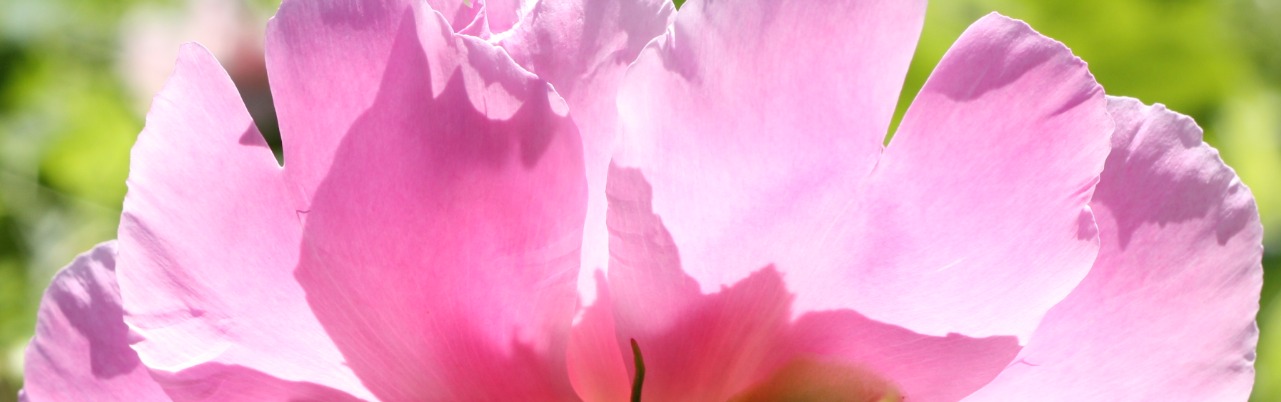
I promised you peonies.  Here, at last, are but a few of the thousands unfolding their hearts at Gilsland Farm right this very moment.  You'll notice that while many are planted and carefully kept in the gardens, others are allowed to grow among the wildflowers in the fields.  I love them grown both ways.  

Tucked in with the photos I've included a few translated haiku about peonies.  Wishing my friends in the Northern Hemisphere a Happy Summer Solstice.  I'm off to climb a mountain now.  A little one, but a mountain nonetheless.  


My rice bowl
filled to the brim
one peony

~Buson


My hut garden
is narrowed by
blooming peonies

~Nabuti Sato


"The peony is this big!"--
the child's arms
outstretched.

~Issa


In the stillness
between the arrival of guests--
the peony.

~Buson